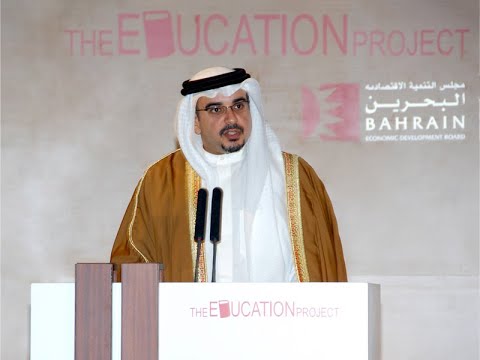

Education Project Conference
Your excellencies, your highness, ladies and gentlemen.
I am delighted to welcome you here because three things matter above all to the future of any country:
– Education, education and education.
Of course, nobody in public life today has the luxury of focusing on just one issue at a time. But you should prioritise between the competing demands on your time and resources. We in Bahrain have no doubt that education must be at the beating heart of a nation’s plans for the future.
For us, this commitment is not a passing phase. It is a permanent trend.
Let me tell you why. Our Kingdom’s commitment to education began 90 years ago.
It was then that our first public education system was introduced, in 1919. Ever since then, successive generations of leaders have inherited what we see as a duty, as well as a privilege, to maintain our tradition of educational reform.
Bahrain’s first school for girls was set up in 1928. An uncompromising commitment to gender equality and a first in the Arab world.
Our commitment today is just as passionate: To keep improving the education and training opportunities for all our people, regardless of gender or religion or income.
We cannot do everything at once. But we will do as much as we can, as fast as we can.
We do this because people are what make a country.
People are key to a country’s growth.
And they are entitled to the education and training they need to win good jobs and a good income for their family.
This idea is not entirely altruistic. It is in the interests of the Government and the national economy to ensure a steady supply of skilled and qualified workers to improve industrial productivity and thereby stimulate economic growth.
So, you may say, virtue and national interest go hand in hand. That is always the safest way to ensure that a reform will stand the test of time.
But honouring our commitment to a good education for all has grown more complex and difficult for every country, because the global economy is highly competitive and changing fast.
That is why we are here today.
We all know there are gaps in the quality of the world’s education systems.
We all know that, in spite of good intentions, increased spending on education often fails to deliver the expected improvements.
The facts themselves are cause for concern. Let us look at some of them.
Britain’s National Foundation for Education Research says that – in spite of endless changes – no measurable improvement in the standards of literacy and numeracy has been recorded in UK primary schools in 50 years.
Just looking at mathematics, Australia has almost tripled education spending per student since 1970. No improvement in average mathematical scores, as measured by the OECD.
Similarly, in the United States, spending has almost doubled since 1980. Class sizes are the lowest ever. And also no improvement in average mathematical scores.*
The problems are even worse in the emerging world.
UNESCO’s Institute for Lifelong Learning tells us that 774 million adults are illiterate and – to our collective shame – globalmarch.org, the movement against child labour, calculates that 246 million children are being exploited in forced labour when they should be in the classroom.
sources: OECD; TIMMS; Economist, Oct 18, 2007
Yet a single year of primary school increases the wages people earn later in life by 5 to 15 percent for boys, and even more for girls.
And for each additional year of secondary school, a person’s wages increase by 15 to 25 percent.
Too many young men and women, in developed as well as emerging nations, are thrown into the jobs market without the skills they need to stay afloat in post-industrial, knowledge economies. And, as I have argued, this is not merely a tragedy for the individual but a loss for their national economies and Governments that need revenues to carry out their obligations.
In a region like ours, the Gulf, with a population explosion of young people requiring employment, the search for solutions is all the more urgent.
Identifying and investing in the right sort of education to unlock the full potential of every individual is one of the great challenges facing the world of the twenty first century.
The Education Project has been set up as an international forum to address that challenge
The Education Project will be an annual event. You can’t solve problems this big in one session.
We intend the Education Project to be a practical event. A chance for educationalists to work together as an international team.
With a focus on doing, not just talking.
It is about sharing ideas and innovations and reforms so the hopes of the next generation can become attainable aspirations, not impossible dreams.
This means seeking answers to the hardest questions: how do we get the best teachers; how do we get the best out of them; how should we intervene with remedial help when students start to lag behind; does it ever make sense to reduce class sizes without finding extra money to keep salaries from falling; can targets be a hindrance, not a help, because they may distort priorities?
The questions are easy. The answers are not.
Let us take advantage of the Education Project to explore solutions and strategies that can help educators around the world to shape the future of education – and make a difference, for every society and for every section of that society.
None of us should expect to have a monopoly of knowledge or wisdom. These are open discussions, open to every stakeholder and open to every idea. From the private sector and big corporations as well as public bodies.
The Project has grown out of Bahrain’s experience in looking and learning from best practice in the best education systems around the world.
What we have learned above all is that education is a constantly moving target. You simply cannot afford to be complacent. Despite having a well established education system, recognised as a regional leader, we realized we had to reform when we took a concentrated look at where we stood globally.
To put it right, we initiated a comprehensive reform programme, and I would like to mention just a few of these initiatives which have already been achieved and implemented. For example:
We established the Quality Assurance Authority, the QAA as we call it, as an independent body to ensure high educational standards by reviewing all educational and training institutions operating in Kingdom.
We introduced a new Teachers College based on best practice from the world’s leading educational models. In this case, Singapore.
We recently launched the Bahrain Polytechnic to give Bahrainis the skills that businesses really need today. As opposed to shuffling people through universities just to get a degree with the word ‘uni’ on it.
We have also recognized those with exceptional talent need to be nurtured to reach their full potential. To achieve this, I have spearheaded the Crown Prince’s International Scholarship Programme, where young women and young men are drawn from public and private schools – fully funded – to attend some of the world’s most prestigious universities. Our young ambassadors have excelled at Harvard, Yale, Oxford and Cambridge and many other great institutions around the world.
Ladies and gentlemen, nothing is beyond the reach of anyone if they set their minds to it. Bahrain is making good progress towards the productive, highly-skilled and bilingual national workforce that we must have if we are to be well equipped to face the future.
And we all have much to learn from each other. And to keep learning – because today’s new knowledge quickly becomes tomorrow’s old history.
The Education Project is an opportunity to showcase innovations that have succeeded in one area – and, we hope, can successfully be adapted for another.
In this way, we can together create a practical roadmap, with new information and insights for educators to follow around the world.
We are privileged to have here today experts from all facets of education, from pre-school all the way to higher education.
And, nor must we forget vocational training, because it nurtures the skilled workforce which thousands of businesses need to grow, and millions of men and women need for satisfying careers and income.
Ladies and gentlemen, a multi-cultural event of this kind is still too rare because most – and probably all – countries are still a bit more inward looking and insular than we should be.
Every country has its own way of doing things. Transferring even the best idea from one culture to another is difficult. It demands patience and much cooperation.
Because our Project is new, none of us knows for sure what conclusions will emerge from our educational melting pot. But we do know they can make a difference, for every society.
Thank you for your patience.
The Education Project is an idea whose time has come. Thank you for making it happen.