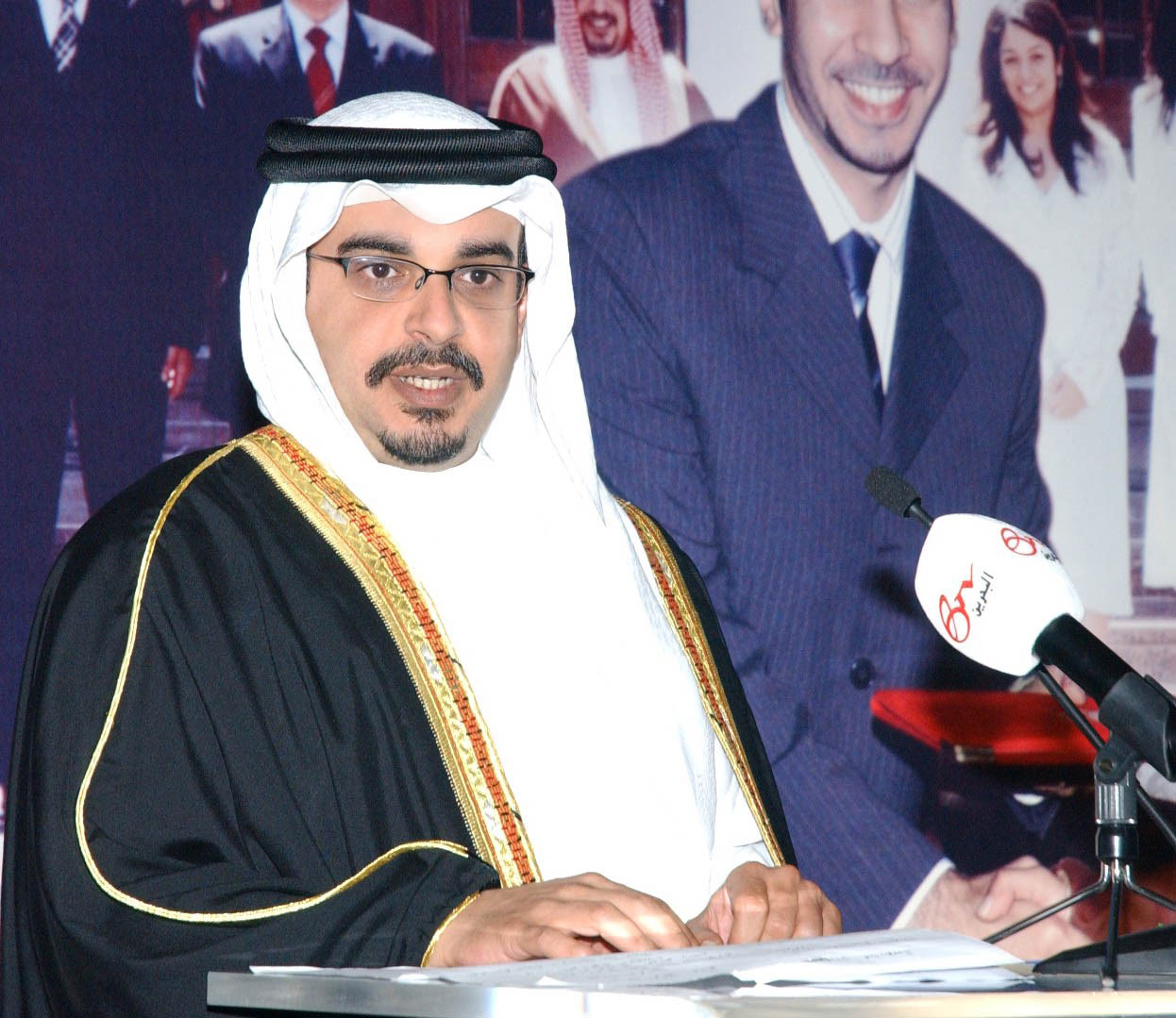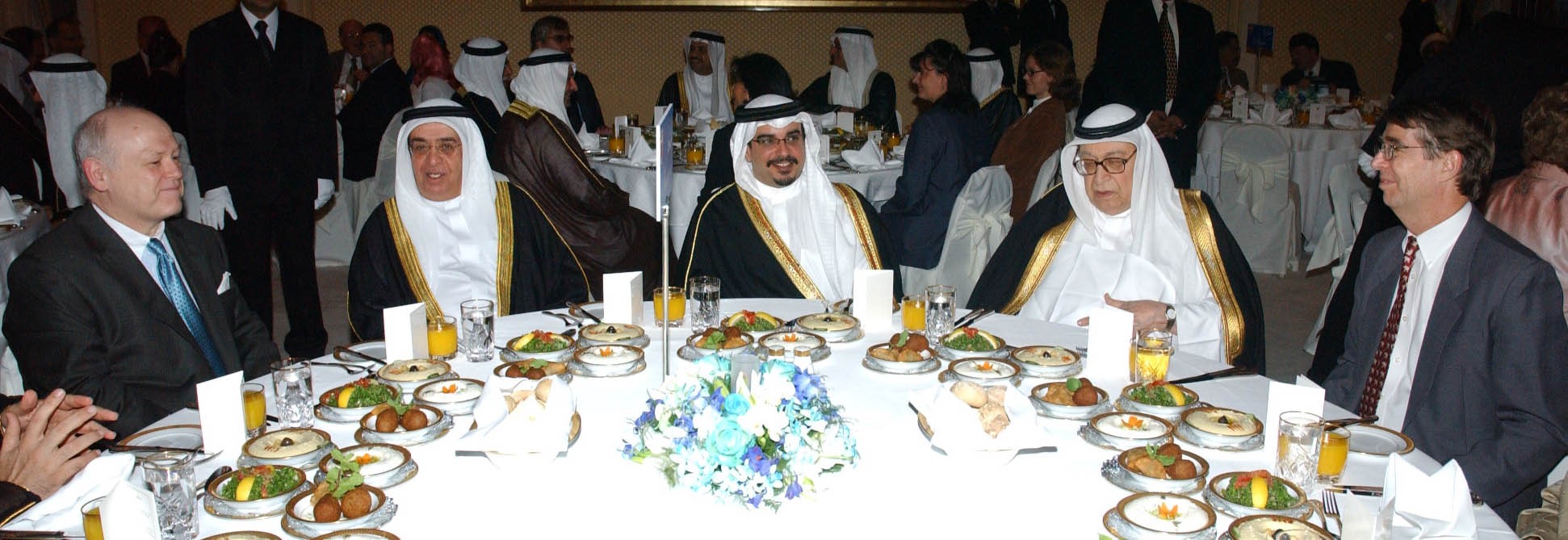

First Annual Crown Prince’s International Scholarship Programme dinner

Good evening ladies and gentlemen.
It is truly a great pleasure to welcome you here this evening.
Thank you for coming from near and far as Ron said – and just to be clear we have had people come all the way from the United States, the United Kingdom and from locally here in Bahrain.
I would like to really, properly introduce this programme to you. You have heard about it, you have read about it. Every year you see a group of young men and women selected to be sent abroad and sponsored for their further and higher education. I want to talk about that and I also want to announce some exciting news, which we will get to later on.
But first of all, let me first speak a little bit about the programme itself. I think it was in August of 1999 when I first met Ron and I told him of my idea to develop a scholarship programme that was to be unlike any other scholarship programme in the region. Little did I know it was probably going to be unlike any other scholarship programme in the world, but that is what we have ended up with. It stemmed from my recognition that, at that time, Bahrain was sending its young men and women off to scholarships that were most likely based regionally. And if they were sending scholars to the developed world ie speaking at least to a member of the G8, they were in very small numbers and for specific tasks. And I felt that was not enough.
I also wanted to develop a scholarship programme that would harness the natural talent of the young men and women of this country. I did not want them to be constrained in any way, shape, or form by any requirements that we may have said; vis-a-vis the major that they must choose, the university that they must go to, or later on in coming back to work for an institution of our choice. So in essence, what I wanted to do was to treat them as young adults and I wanted them to make the choices that would shape their future destiny.
We only made one provision, and at that time, it was to exclude the follow-on studies for medical science – doctors – primarily because we felt at that time and still to this day there was a cultural assumption that anybody who gets high grades in school must naturally become a doctor. And I knew we needed engineers, lawyers, bankers, all sorts of skills in the country. So we were very clear and we wanted to make sure that the students knew that and they were briefed by that.
Now, it is funny our first intention was to send four students: two boys and two girls. Very quickly in the first year we realised that that was not going to be enough because the top percentile were much larger than that, so we expanded the scope to six. And the following year when the results came back – and I will speak a little bit on how we do the selection process – we realised that six was too little so we made it ten. And we decided to split it with six seats going to Ministry of Education students and four to students from private schools. And we split it equally between male and female, so five each.
Now we knew that we had to develop a system that would be transparent, fair and competitive. So what we have done is to establish weightings for grade point average, for the TOEFL test, which is English language test, for the SAT maths and the SAT verbal, and a small percentage for the students’ extra curricular activities. And based on a formula that has been modified slightly over the years, we come up with an aggregate score. So in effect, the students select themselves. We do not select them. It is almost a statistical impossibility for anybody really to try to choose somebody who has proved to be not up to the standards of his or her competitor.
And this was very important because from the beginning we wanted this scholarship to be known as a national one; to be known as a scholarship that would reward talent and empower the students to really seek to achieve their ultimate ambitions. And we are very ambitious when we talk to them. We always try to help the students understand that there are many opportunities to be had, whether through university career offices or by arranging internships here or by arranging trips to specific locations around the world for them, and it has been fantastic.
Let me give you some statistics that you might find interesting. Currently, we have 64 students enrolled in the programme, including the group that was selected this year. Nine have graduated. Eleven more will graduate this year, four of them with Masters degrees.
Those who have decided to enter into the job market are employed at institutions such as GIP, McKinsey & Company, Goldman Sachs, Deloitte Consulting, and one is a teacher in the UK with the programme Teach First. Others are still continuing their higher education or are interviewing with companies such as Shell.
The average GPA of the students who are applying to this programme – converted to a hundred point scale, just so that you know we can equate between the UK, Bahrain and the US – the average is over 97 percent. That is the score that they get: the minimum that will likely lead them to be accepted. The SATs, this is an average score and we have had perfects certainly, is 600 on the verbal and 700 on Maths. So these young men and women are very very very bright.
It also might interest you to know which schools, for the Bahrainis among you, are producing the highest number of scholarship winners. The top private schools are Ibn Khaldun National School followed very closely by Saint Christopher’s and the top girls Ministry of Education school is Khawla followed very closely by Isa Town School for girls. And for the boy the Ministry of Education schools, there is a tie between the al Nuaim and Shaikh Abdulaziz schools with five, followed very closely by the Isa Town Secondary School. So those, ladies and gentlemen, are the institutions which are graduating our people.
We realised also that in addition to making sure that these students had the ambition, had the opportunity, had the access to get to the best schools, we also needed to prepare them. So we make sure that we put enough money into training them in their final year of school here in Bahrain. We teach them pre-SAT courses, pre-TOFEL courses, critical thinking and critical writing. And they have clearly benefited from those programmes.
Let me just present to you an idea before I go back to the meat of the subject, where these students have gone. We have students now studying at Cambridge, at Oxford, at the London School of Economics, at Imperial and at King’s. Bristol, Nottingham and Durham are also on the list. And in the US we have students at Emory, Stanford, Yale Georgetown, Princeton, Wharton and at the University of Pennsylvania. So be under no illusion that these really are over achievers. We need to be very very very proud of them – and I certainly am.
I have decided that we must expand the depth and the ability of this programme to carry these people through their further education. We certainly were able to carry them through their Bachelors degree; we were able to carry a few through their Masters; but tonight I am going to be inviting you to join a really exciting phase of this programme. And that phase is the creation of the ISP – International Scholarship Programme’s – Endowment.
The idea is that we will create an endowment for this fund with the goal of creating under investment or under management about BHD 30 million in twenty years. That money will be used to fund the students through their career whether they do a Masters or a PhD and we are developing or have developed the criteria to test and to assess the students who need to move on.
For example, if they are doing sciences then certainly they need to carry on through the research programme because work experience is rather irrelevant to that specialisation. But for those doing business degrees or other degrees that need professional qualifications, we are encouraging them to take some work experience before they carry on their education.
The structure that we are envisaging is that we will create a board – there is already a board for the programme – but we will create a new board with five seats represented by members from our side and five seats open to our prime donors. And prime donors are those donors who give over BHD 1 million over five years.
We will be creating a set of trustees and those trustees are any institution that donates up to BHD 500,000 over five years. And those trustees can elect the board members. And then, of course, we will have partners, and those are open to donations ranging between I think it is BHD 50,000 to BHD 250,000 over five years.
And the partnership that we are envisaging will allow us to do and to set out the ambitious goals that we have or are trying to execute.
Ladies and gentlemen, I cannot stress enough my commitment to this programme. So it is my intention to match any funds that are donated to this programme to ensure equitable balance on the Endowment board. I invite you to join and I have been speaking with a few of you, and it gives me great pleasure, really really great pleasure, to announce that we have already secured BHD 4 million over the next five years in contributions. Primarily from BATELCO, who were our first sponsor, secondly from Investcorp, thirdly from Gulf Finance House, and fourthly from ALBA. And we have a number of smaller donations which will be made known to you in due course when we publish our annual report.
But this is a big deal, this is I think the most ambitious endowment programme that has ever been launched in Bahrain. I intend to see it through.
And I congratulate and thank our prime donors or prime partners, and assure you that every dinar that goes into this programme is going towards building a better future for all of us here.
Thank you very much. It is my great pleasure to be here tonight and to thank you for sharing this moment with me.
And also, I must extend my sincere thanks to everyone who worked with me on this programme. Shaikh Mohamed, Ron, and all of you at the ISP administration, I could not have done it without you. It is a great honour to work with you over the years and we have achieved something really tremendous and we should, you should, all be very proud.
Thank you again, thank you very much.