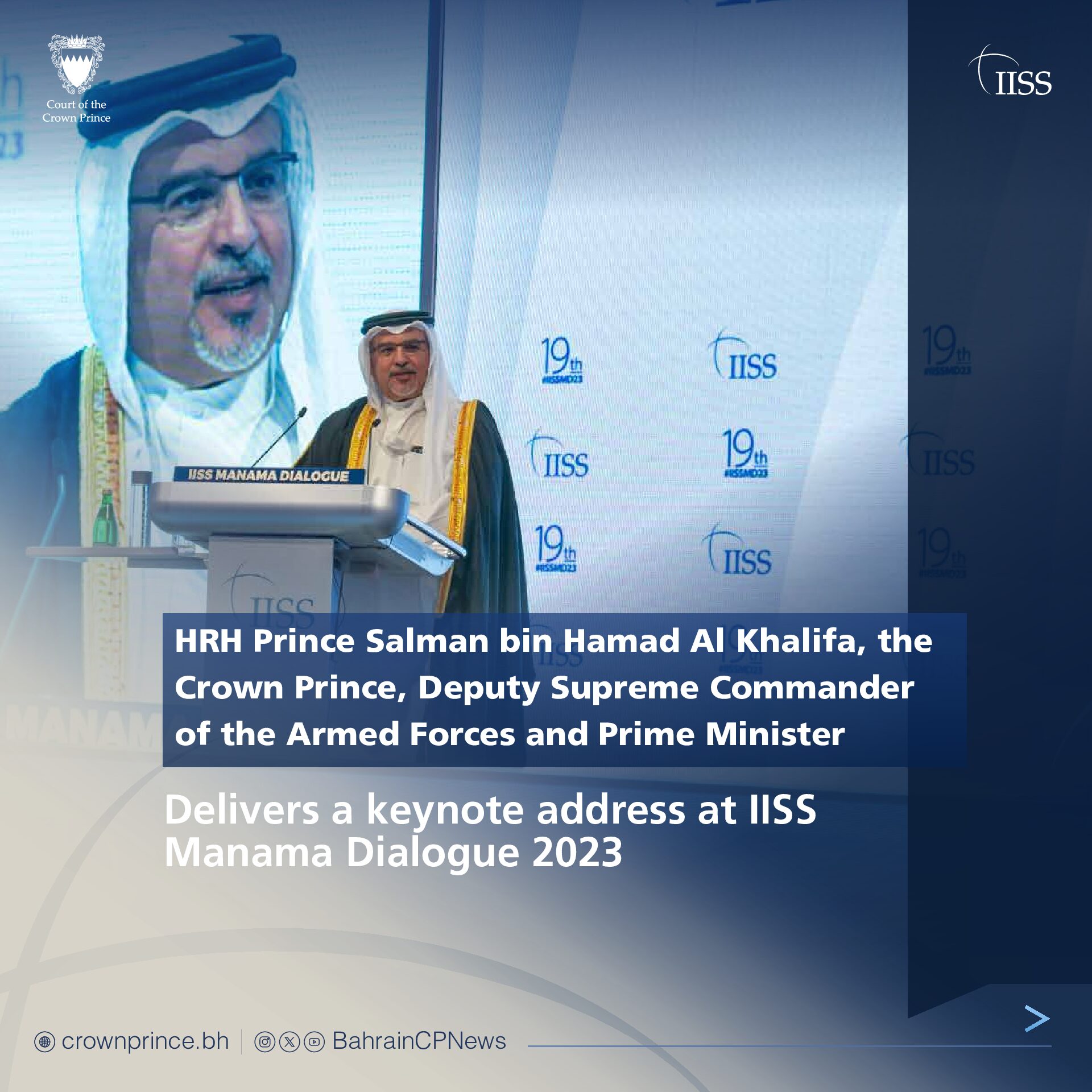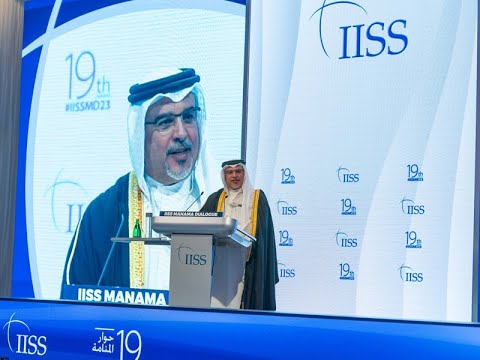

HRH the Crown Prince and Prime Minister delivers a keynote address at the 19th edition of the Manama Dialogue
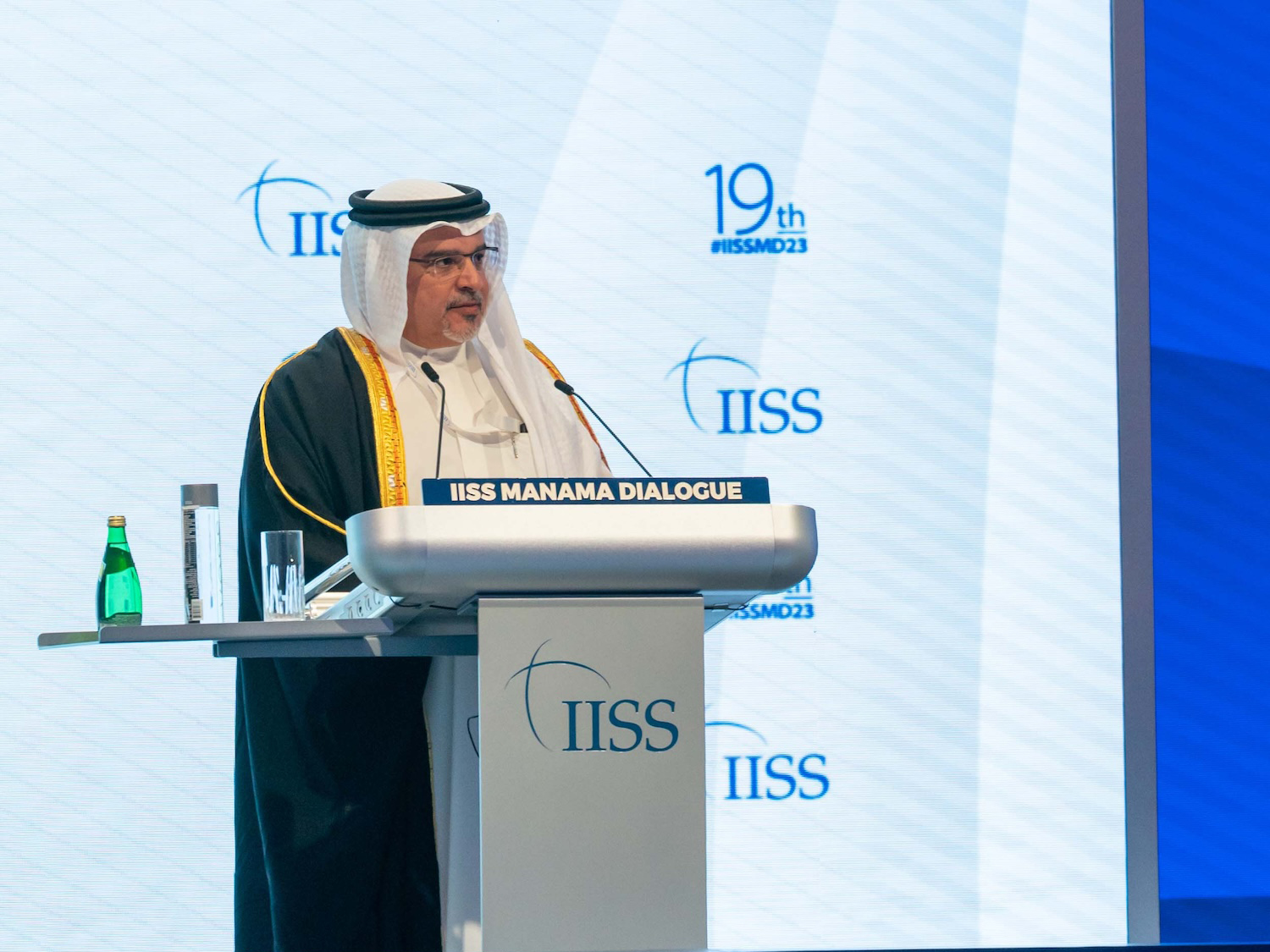
Your Highnesses, Excellencies, distinguished guests, welcome. Welcome to you who have come from inside Bahrain, welcome to you who have come from all over the Arab world and the region, and welcome to you who have come incredible distances – from the United States, from New Zealand, from all corners of the earth. We’re very grateful you are here. There has never been a more urgent time for us to collaborate and coordinate. Dr John Chipman, thank you so much for that introduction. It warms my heart. That was nearly 20 years ago that we spoke in London, and what has been built over the years has been a wonderful tribute to all of the great thinking, the minds, the challenges that the world has faced over this very interesting but, I think, fundamentally transformative time.
We were right in the middle of the peace dividend at the end of the Cold War, entering into the new world order where countries had broken, new vacuums were created, September the 11th was still on people’s minds, to where we are today, pre-COVID, I would say, potentially with a fully functioning international order that has suddenly, after COVID, looked a little bit shaky.
So, without further ado, I had accepted to speak before 7 October, and my subject matter that I was going to speak about was the global rules-based order. And I was going to specifically discuss CSIPA (Comprehensive Security Integration and Prosperity Agreement) and all of the great benefits, and all of the dangers that associations and integrations such as that will play going forward in the international community.
Well, 7 October happened. So now that the war is raging in Gaza, that must take precedence, and I must speak on it. It is a tough job, and many speeches have been given about the situation as it stands today. I had the honour of delivering Bahrain’s speech at the Islamic Conference in the Kingdom of Saudi Arabia, ably organised, I must say; and this speech is going to be slightly different. This is not a positional speech with a regurgitated copy that keeps being repeated over and over again. So, forgive some colourful language, potentially, forgive some interesting language, potentially.
But when I say it’s a tough job, it can’t be as tough as living under the constant bombardment of bombs in Gaza today, with no running water, no running sewage, no internet, no phones, and the lack of surety if you’re going to wake up tomorrow or if you’re not. This is an intolerable situation, and we must do everything in our power to stop it. Now, both in Islam and Judaism, the protection of innocent life is a duty and a moral responsibility. In the Quran, it says that the killing of an innocent – an innocent is clearly defined as one who has not spread corruption in the land or committed murder – is akin to killing all of mankind. And in the Abrahamic faith, the saying is, ‘To save a life is to save all of mankind’. How wonderful.
Now, both sides in this conflict haven’t lived up to that, and I think our condemnation must be to both. I condemn Hamas unequivocally. This is so everybody in the room can understand that I stand on the side of civilians and innocents and not on the side of political posturing. The attacks on 7 October were barbaric, were – how can I put it, they were horrific, they were indiscriminate, they killed women, children, elderly; did not matter. They hit civilian institutions, and they hit military targets. And on top of that, it seems it’s okay now to grab hostages and take them away and speak about it as if it’s an act of war. That is something that we condemn, and we condemned it on 9 October, I believe, or 8 October.
Now, Israel. I unequivocally condemn the air campaign that resulted in the death of over 11,000 people in Gaza, 4,700 of which are children. Now, both of these actions have led to the death of innocents. Both of these actions did not save the entirety of mankind and, in effect, are the equivalent of killing all of mankind. Both are reprehensible, both must stop, and both are a thing that we must deal with, with the greatest care moving forward, because what we need to do is to break this cycle.
And let me speak a little bit prescriptively about how I think this can be achieved. Two of the most important things we must do today are to get the hostages out, and in order to do that, we have read an open source that the State of Qatar is working alongside with its partners in the United States and in Israel and with Hamas to release hostages, in exchange, we read – this is not corroborated – for prisoners who are also held within the State of Israel. Now, this is to release women and children on both sides, non-combatants, innocents. And this, I believe, is one component of what will achieve a break in hostilities. You want to call it a ceasefire, you want to call it a pause, you can call it whatever you want. The intention is a break so people can take stock, people can bury their dead, people can finally start to grieve, and maybe people can start to ask themselves about the intelligence failure that led to this crisis in the first place; but let’s get to that later.
And the second thing that I think is needed is for the role of international law to be fully implemented in the conduct of war, and that is to allow the access of humanitarian aid. We have seen what has happened at the Shifa Hospital, Al-Quds Hospital, name it. Any facility that is caring for the weak, the young, and the sick, we need to be sure that we can provide them with medicine, we need to be sure that we can provide them with fuel so that they can run their machines, their incubators. We need to be providing the people of Gaza with food. And I genuinely believe that the only way to achieve this is to achieve this hostage trade as soon as humanly possible.
So, from this stage, I call on Hamas to release the hostages: the women and children, who they hold hostage in exchange. And I call on the Israelis to release the women and children they hold in exchange so that we can get some sense and a few days, or weeks, or months, or maybe years of peace and calm. I don’t think any Arab leader has called on Hamas to release the hostages. So, it is a time for straight talking, it is a time where political positioning – and actually, the perpetuation of poisonous narratives, opposing narratives must no longer be our methodology. We’re all here to end this war. I don’t care who started it, I don’t care who will end it. I care that we all work together to make sure that it ends as quickly as possible.
So, building on that, we all know that this conflict didn’t start on 7 October. This latest escalation did, but the conflict has been an ongoing open wound in the Middle East for the past 80 years. And here’s the kicker: no real security will ever be realised until a real two-state solution is found. So, preserving this path to peace will demand strong leadership from us in the region and primarily from the great powers, and specifically from the United States. We believe that the United States is indispensable in leading this process. So, if that is the case, let’s try and draw some red lines, somewhat along the lines of the Tokyo Declaration.
And let me be extremely clear what matters to the Kingdom of Bahrain. There must be no forced displacement of Palestinians in Gaza, now or ever. There must be no reoccupation. There must be no reduction in Gaza’s territory. And on the other side, there must be no terrorism directed from Gaza against the Israeli public. So, that is very clear. Those are the red lines. And central to this, central to finding that two-state solution, is that the Palestinian people’s hopes and aspirations must be at the centre of any post-crisis governance.
In the immediate aftermath of the war, conditions must be set to deliver elections. This is something President Mahmoud Abbas called for at the Islamic Conference. This is a key demand, and the Palestinian Authority is the sole legitimate representative of the Palestinian people today. Listen to what he’s saying. Elections will lead to that, lead to a strong, unified leadership across Gaza and the West Bank that can deliver hope and prosperity to the Palestinian people for years to come. And not only that, this organisation – this process, must lead to a serious interlocutor and partner in delivering a just and lasting peace with a viable and independent Palestinian state as its goal, and also deliver security and stability to its Israeli neighbour.
Now, failing all this and allowing the base rules of war to govern the outcomes here in the Middle East will only increase a very worrying trend I have seen on the international stage, and that is the erosion of the rules-based order. This is something that I was going to speak about. This is now actually putting it even sharper focus. Military conflict or use of force cannot be the final arbiter in international disagreement. Diplomacy and international law must win. This stands here in Gaza and in the aspirations of Palestinian people, it stands in Russia and Ukraine, it stands in any other geography where people may fight over territory. And if we allow these institutions to erode, then I promise you what you’re seeing in Gaza will just be the beginning of powerful states imposing their will on weaker states, and nothing will stop it spreading until we are in a conflagration that consumes a great proportion of the world.
So, ladies and gentlemen, I am not one to speak for too long. I think I’ve been extremely clear. The abhorrent, abominable situation that the civilians of Gaza are existing under right now is something that I cannot, in good conscience, just let slide. We have to do everything in our power to prevent this, and that means working across lines, political lines, working with all of the parties involved to make sure that our voice, our reason, our best wishes for everybody get through.
And I’ll leave you with one image. There’s a worrying concern I have, which is the Russian invasion of Afghanistan created al-Qaeda, the invasion of Iraq allowed ISIS (the Islamic State) to flourish in the vacuum. Think what this will create in the age of social media. Not only do we risk the abject misery of a whole population, but we are creating the conditions for acts of violence to spread all over the world, and failing – our inability to stop it, so encouraging them to do those things that need to be done to stop the war, I think we will be looking at a far more difficult next 20 years.
So, ladies and gentlemen, thank you very much for taking the time to listen, and I wish you all the success in changing the narrative. Thank you.