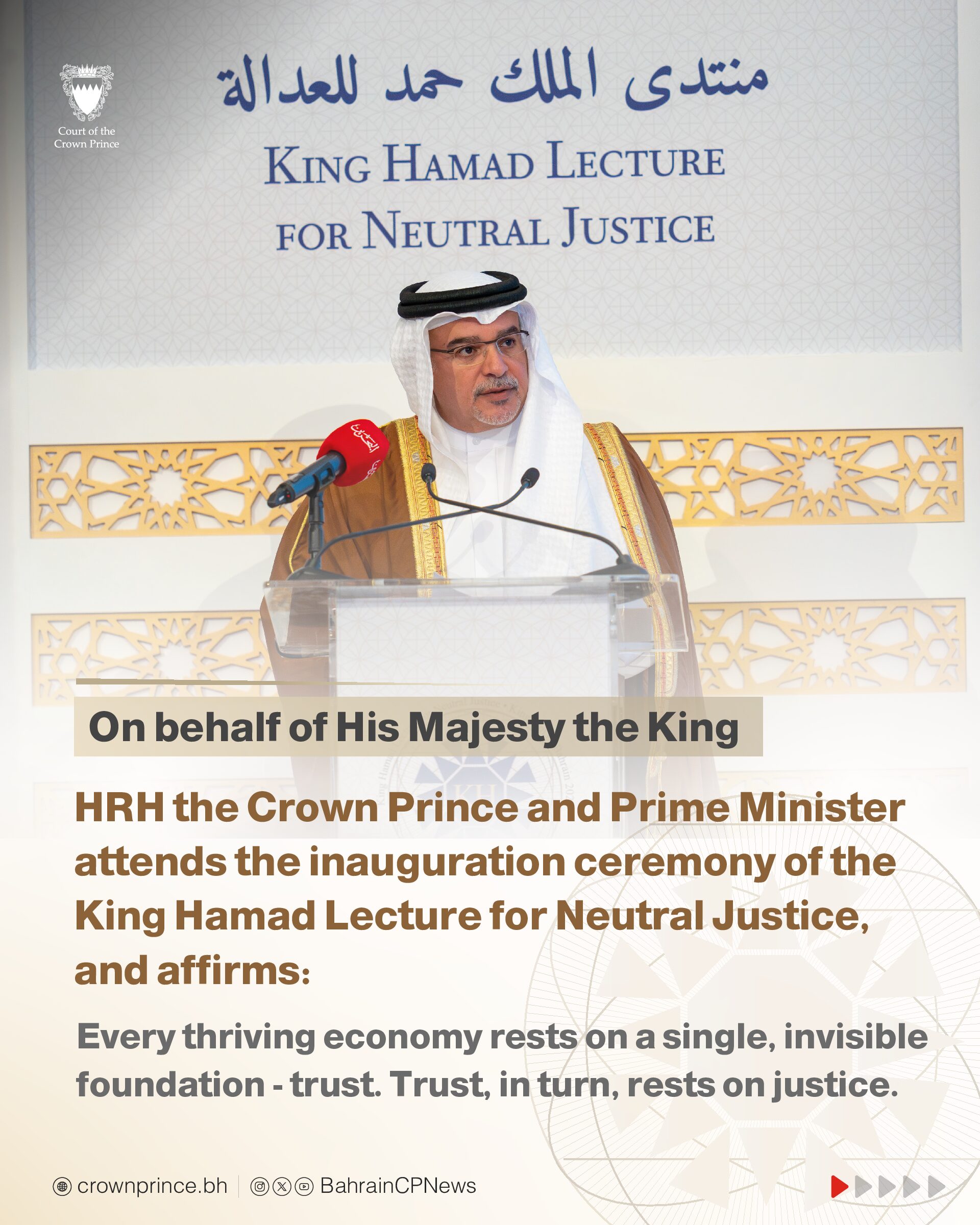

HRH the Crown Prince and Prime Minister attends the inauguration ceremony of the King Hamad Lecture for Neutral Justice
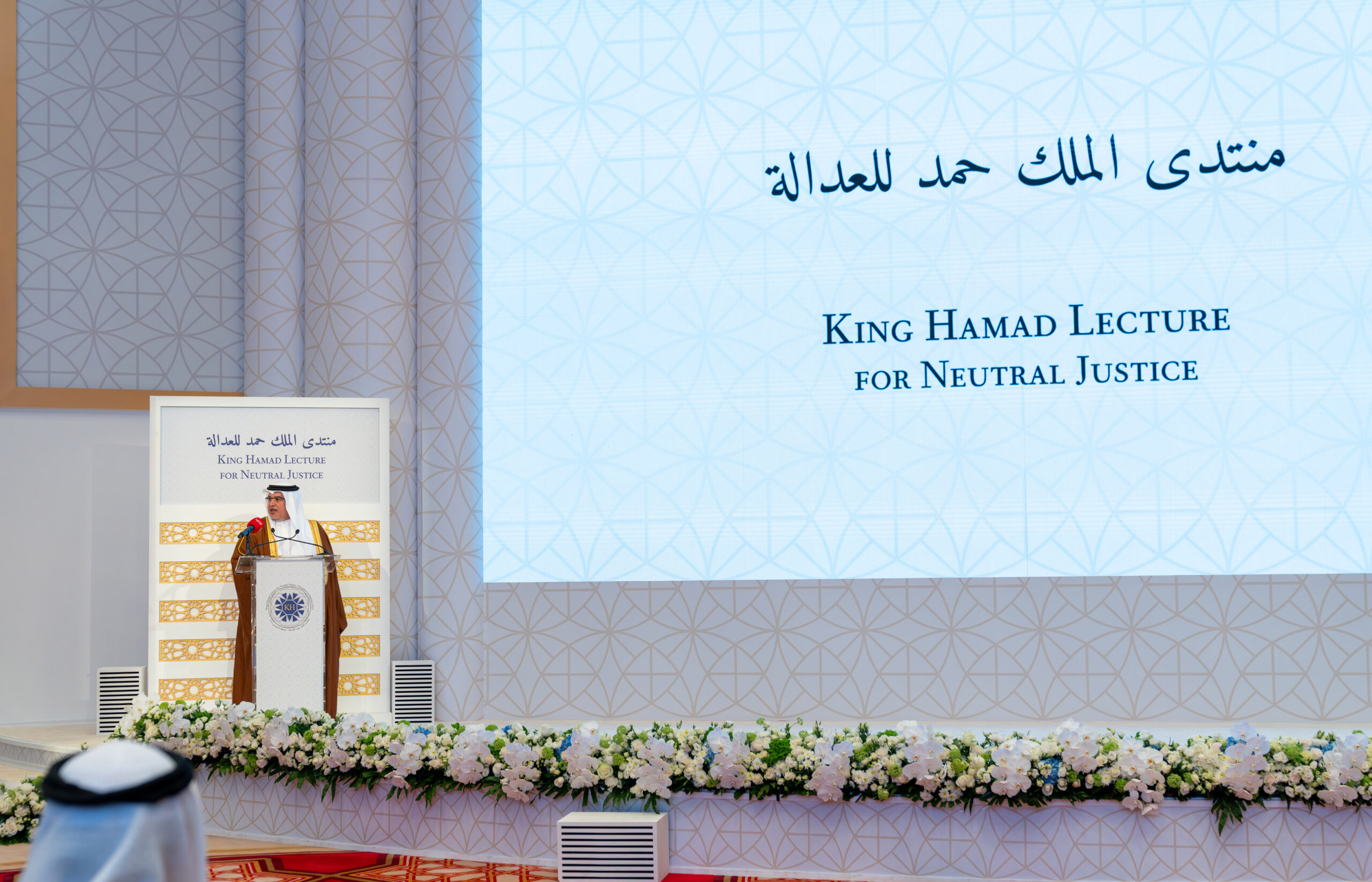
Your Highnesses, your Honours, your Excellencies, distinguished guests,
On behalf of His Majesty King Hamad bin Isa Al Khalifa, it is my honour to welcome you to the King Hamad Lecture for Neutral Justice – a first-of-its-kind dialogue dedicated to advancing the principles of fairness and impartiality.
Today marks a defining moment for Bahrain, with the launch of the Bahrain International Commercial Court and the introduction of “Global Justice Bay,” a new hub positioning Bahrain as a center for dispute resolution and international legal collaboration. Allow me to begin with a word of gratitude to our partners and friends from the Government and judiciary of Singapore, in particular Chief Justice Menon and his team.
Your collaboration has been central to making this day possible. We are deeply grateful for your friendship and your faith in what we are building together.
I would also like to acknowledge the unwavering dedication of our judges, legal experts, and officials whose collective efforts have transformed this vision into a reality.
Dear Guests,
Every thriving economy rests on a single, invisible foundation – trust. Trust, in turn, rests on justice.
And justice is rendered through strong institutions.
It is institutions, therefore – not rhetoric – that ensure markets remain fair, disputes are resolved peacefully, and that the rule of law is upheld when the world seems uncertain.
When Bahrain began this programme, our goal was simple: to build a system that upholds integrity, and delivers justice efficiently. The Bahrain International Commercial Court stands on three simple ideas.
First, that justice enables prosperity.
Some say that law and commerce exist in tension – that regulation constrains enterprise. But experience shows the opposite.
Trade does not flow where contracts are uncertain.
Investment does not endure where law is unpredictable.
And prosperity cannot last where trust is absent.
The rule of law is not a brake on economic growth; it is its engine.
Second, that independent institutions command trust.
This Court will operate as an independent body. Its judges will come from Bahrain and from some of the world’s most respected jurisdictions.
Its independence is not just a structural feature – it is a statement of intent.
It means that justice here will be seen to be fair, impartial, and rooted in principle.
And it means that Bahrain’s reputation, and that of our region, will grow stronger with each fair decision rendered.
Finally, and third , that justice must adapt to the age we live in.
The world’s economy today is digital, fast-moving, and deeply interconnected.
Disputes cross borders as easily as data does. Our legal systems must therefore be agile – adopting technology, streamlining processes, and ensuring that the delivery of justice keeps pace with innovation.
The Bahrain International Commercial Court has been designed to combine the precision of law with the speed of modern business. It will serve both regional and international enterprises with efficiency and transparency.
Distinguished guests,
For centuries, our islands have been a crossroads of trade – a place where merchants met, ideas converged, and trust was the currency of exchange.
This Court is a continuation of that story. Bahrain’s openness extends beyond culture and commerce – it is embedded in our legal and institutional frameworks.
And it signals to the world that Bahrain is ready to play its part in shaping a more predictable and just global trading system.
Of course, there is no end point on this journey – just another step. We will continue to invest in our judiciary, in our legal education, and in the partnerships that sustain excellence. We will continue to reform, to team, and to innovate – because justice demands relevance. And we will continue to engage internationally, confident that Bahrain’s example can inspire progress well beyond our borders.
Bahrain now has another pillar of strength. And the many efforts that went into making this a reality have helped build an institution that, we hope, will serve generations to come.